

Robot Data Acceptance: Name the Quantile Method
2026-11-02
Robot Data Acceptance: Name the Quantile Method
A quantile method belongs in the acceptance record for a robotics-data summary. A label such as percentile or quartile does not fully describe how a supplied cut point was obtained. Before comparing summaries from two implementations, a buyer should ask which method and input scope each one uses. This article proposes that review. It analyzes no market dataset, calculates no cut point, and reports no current robotics statistic.
Ask what the summary is intended to describe
Start with the population or sample context the supplier claims for the input. A collection of observations needs a defined scope before its summary can be interpreted. The receiving team should not infer that scope from a familiar table heading or an attractive chart.
The buyer should also identify the purpose of the comparison. Checking that two exports use the same documented method is different from deciding whether the data answers a market question. The acceptance note should keep those tasks distinct.
For the hypothetical handover, leave all observations unspecified. The checklist can ask about input selection and method without inventing a distribution. A plausible numerical example might illustrate arithmetic, but it would not establish what a real robotics dataset contains or how a supplier processed it.
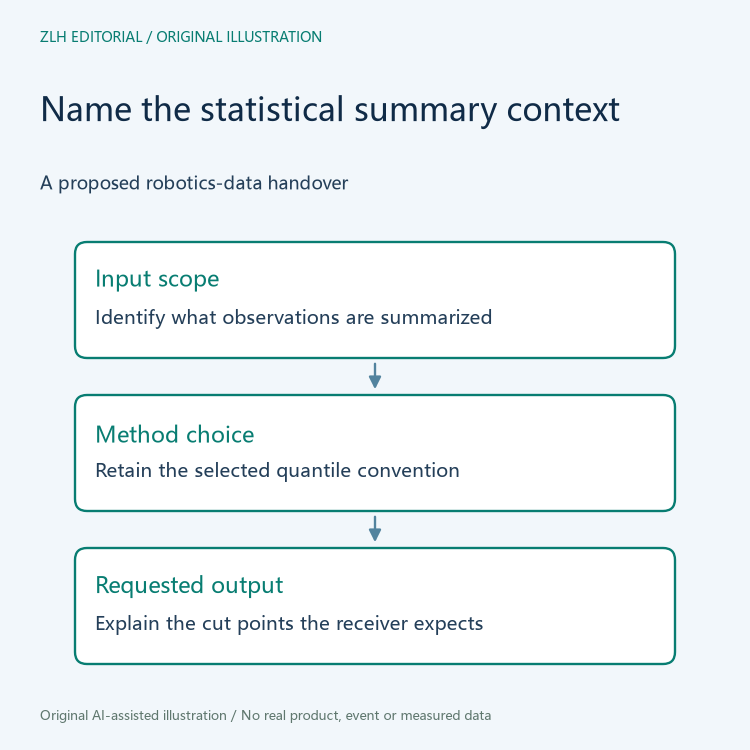
Name the method rather than rely on the function label
The NumPy quantile reference documents multiple methods for estimating quantiles. It describes the method parameter and the available conventions. The receiver should therefore ask which actual method was selected, not just whether the supplier used a quantile function.
Ask the supplier to retain the implementation and relevant configuration with the reported summary. An unchanged function name does not necessarily communicate every choice made by the analysis. A reviewer should be able to identify the method without reconstructing it from the final cut point.
The official reference is technical background. It does not decide which method is appropriate for an actual procurement or market-analysis task. That judgment needs the data context and the supplier’s stated rationale, neither of which is supplied as a real case here.
Distinguish the requested output convention
The Python statistics documentation describes quantiles as dividing data into intervals and returning the separating cut points. It also describes exclusive and inclusive methods with different assumptions about the relationship between observed extremes and the population context.
Ask the supplier which output the receiver expects and how it relates to the named method. A requested probability location and a request for a set of separating cut points are not interchangeable descriptions of an interface. The delivery note should make that convention explicit.
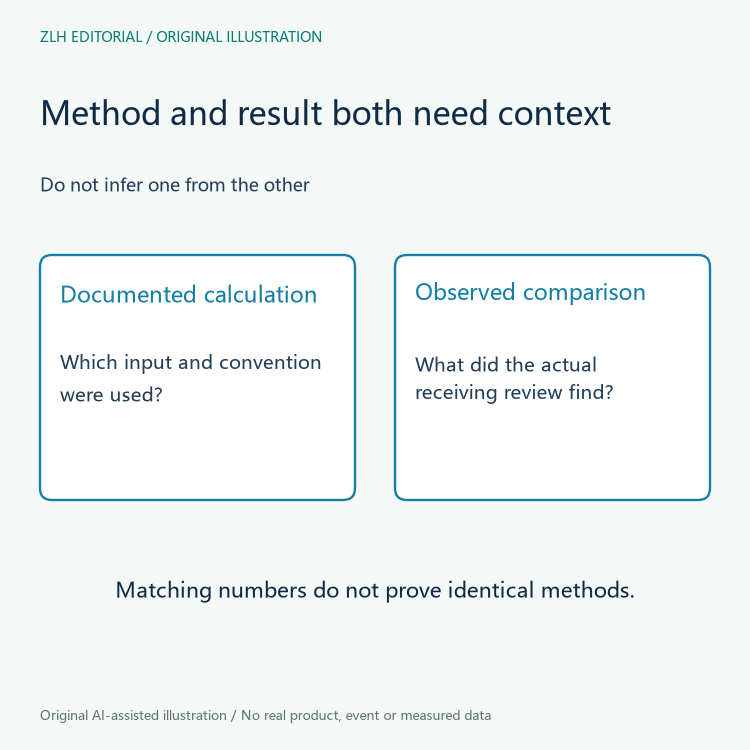
No output array is created in this article. Documentation examples should not be copied into a robotics report as if they were measured results. A later authorized comparison needs the actual inputs, method, requested output, and observations.
Keep input preparation visible in the acceptance record
The method alone does not identify the supplied observations. Ask which records were included, what quantity was summarized, and which transformations preceded the calculation. These questions belong beside the statistical method rather than hidden behind a final percentile label.
A receiving reviewer should not merge different units or observation scopes merely to obtain one summary. If the supplier’s preparation is unclear, request clarification. The current checklist does not claim that any real data needs conversion or that a particular transformation is appropriate.
Interpret a disagreement without inventing a cause
If two later summaries differ, retain their inputs and method context before assigning a cause. Different conventions are one question to examine, not a diagnosis that can be made from a pair of unexplained numbers. Preserve uncertainty until the actual evidence supports an explanation.
Similarly, matching outputs do not by themselves establish that the same method or dataset was used. The receiving record needs the underlying context, not merely numerical agreement. A comparison should be attributable to its actual objects and scope.
Do not turn a cut point into a guarantee about future installations, individual equipment performance, or the whole robotics market. A statistical summary has the scope of its defined data and method. Broader claims need appropriate additional evidence.
Accept an interpretable statistical handover
The proposed delivery should identify input scope, selected quantile method, implementation context, requested output, and actual observation. Missing information can remain an open item. This lets another reviewer understand what the summary means before comparing it with another report.
When the supplier changes a method or input selection, ask which earlier comparisons need renewal. Preserve previous summaries with their own context rather than overwrite them as if the new convention had always applied. A stable table title should not erase that revision boundary.
More methods appear in our robotics data section and the reading directory. Both original illustrations contain no actual samples, numerical cut points, market totals, computed ranks, or completed statistical acceptance results.


