

Robotics Market Tables: Left Joins and Repeated Keys
2026-11-04
Robotics Market Tables: Left Joins and Repeated Keys
Why a merge can silently change the number of rows
When an analyst combines a robotics market table with a reference table in pandas, the row count of the result is not guaranteed to equal the row count of either input. The merge() function implements SQL-style joins, and the how argument controls which keys survive in the output (pandas user guide on merging). A left join keeps only keys from the left frame, similar to a SQL left outer join, and preserves the key order of the left table. That behavior is easy to describe but harder to verify in practice, because the same call can produce one output row per left row, or many, depending on what sits in the right table.
For the hypothetical review, begin with what one row is meant to represent after the proposed merge. If several right-side records match a left-side key, the resulting combinations need an explanation. They should not be counted as additional robot models or additional market activity merely because the joined table is longer. No source table was merged for this article.
Left join semantics: retention, not duplication by itself
In a left merge, every key present in the left frame appears in the result at least once. Keys that have no counterpart in the right frame still appear, with missing values in the columns that would have come from the right side. The pandas reference notes that how='left' uses only keys from the left frame and preserves key order (pandas.merge API reference). This is the mechanism that makes a left join attractive for market tables: you can attach descriptive attributes from a reference table without dropping the observations you already have.
The join direction and the key relationship answer different questions. A left join specifies which side supplies the retained keys. One-to-one, one-to-many and many-to-one describe uniqueness relationships for the selected keys. Repeated right-side matches can expand a left row regardless of the informal name given to the table. Establish the actual key relationship rather than inferring it from the file name.
Consider a hypothetical qualitative market table for a robotics industry dataset. The left table lists robot models with a classification label such as "articulated" or "SCARA" and a region code. The right table is a reference of classification notes, one row per classification label, describing what the label is intended to cover. A left join on the classification label is many-to-one: each model row picks up exactly one note row, and the output has the same number of rows as the left table. Nothing has been duplicated, and no model has been dropped.
Many-to-many multiplication: the Cartesian product inside a key
The case that surprises editors is the many-to-many join. The pandas user guide states that for a many-to-many join, if a key combination appears more than once in both tables, the result contains the Cartesian product of the associated data (pandas user guide on merging). In plain terms: if the left table has three rows carrying key K and the right table has two rows carrying key K, the output will contain six rows for key K. The multiplication is per key, not global.
For a fictional example, imagine a table that retains separate model entries and another table that retains several descriptions for a shared classification. A merge on that classification can associate one input row with several matching descriptions. Before interpreting the resulting records, ask what each matching combination means. No numerical market table or actual merge was produced here.
The pandas.merge reference explains that validate='many_to_one' checks uniqueness of the right-side keys; validate='one_to_many' checks uniqueness on the left. The many_to_many option permits that relationship without a uniqueness check. If the intention is to attach at most one matching reference record to each left row, the relevant uniqueness question is on the right. A check still needs to match the intended methodology.
Row count is not growth, and multiplication is not deduplication
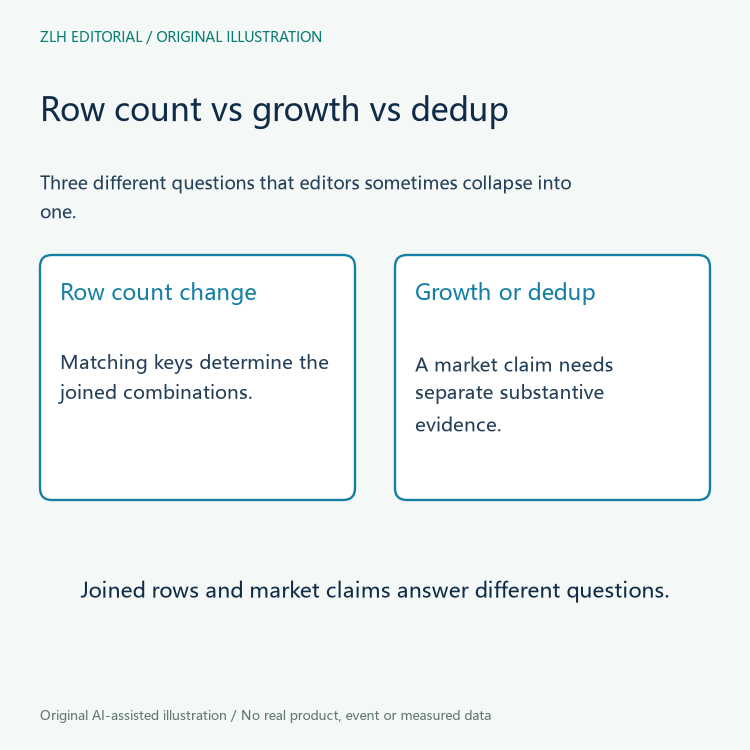
An unchanged result count alone does not prove that the entire right table is unique. Duplicates under keys that do not match the left table may not affect this particular left join. Inspect the relevant key definitions and use the intended uniqueness check rather than treating a count comparison as a complete integrity test. A higher count is a reason to inspect matching combinations, not a measure of market expansion.
Growth, by contrast, is a comparison of the same measure across two time periods. It requires a defined denominator, a defined period, and a defined unit. A merge that multiplies rows because of a many-to-many key relationship does not describe growth; it describes a change in the granularity of the table. Conflating the two is a category error. An editor who reports "the number of rows doubled after joining the segment tags" as if it were a market expansion has mistaken a data-modeling artifact for a substantive finding.
Deduplication is a separate operation again. Removing duplicate rows after a merge is a choice about what the analyst wants one row to mean, and it must be documented as such. The pandas reference notes that indicator=True adds a _merge column recording whether each row's key came from the left only, the right only, or both (pandas.merge API reference). That column is an audit trail, not a deduplication tool. Deciding which rows to keep, and why, belongs to the analyst's methodology note, not to the merge call.
A practical audit sequence for a robotics market table
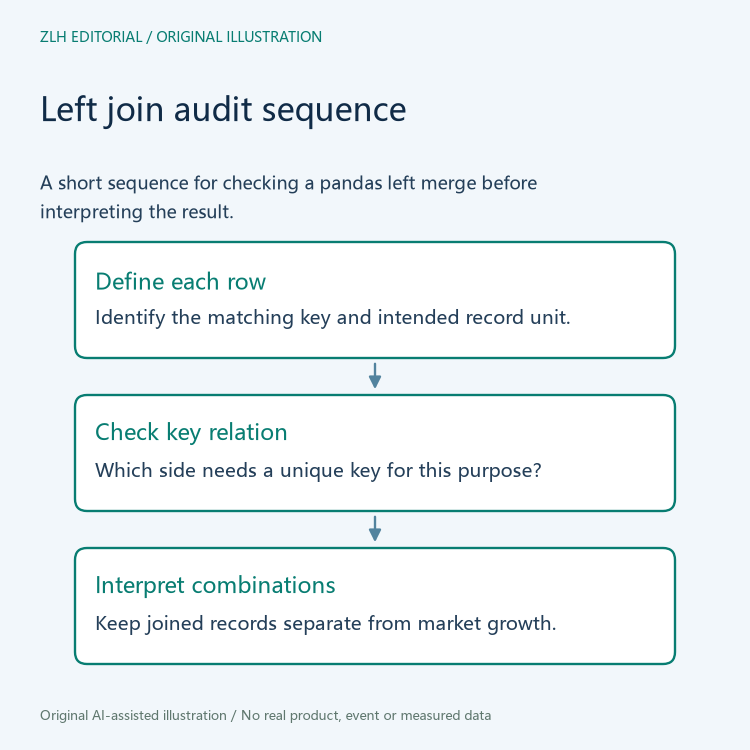
Before a proposed merge, describe the unit of a row in each fictional input and choose the actual matching key. A model-to-tag relation is not automatically many-to-many: if the model key is unique on the left and repeated on the right, the key relationship is one-to-many. The selected keys and their observed uniqueness determine the relationship, rather than the general names of the datasets.
The indicator column describes whether a result key is associated with the left side, right side or both. It does not by itself explain the multiplicity of matching rows. For a left join, inspect the actual repeated matching keys and their associated records when investigating expansion. Preserve the distinction between a row-origin label and a uniqueness check.
Finally, keep the row-count audit separate from any substantive claim. A note reading "left join on classification label; output rows equal left rows; reference table verified unique on label" is a statement about the data pipeline. A note reading "the market grew between the two periods" is a statement about the world, and it requires its own evidence. The two notes should not share a sentence. For a broader view of how market tables are structured and documented, see the internal guidance at /type/25.html and /type/17.html.
Common failure patterns and how to read them
One frequent pattern is the silent many-to-many join on a column that was assumed unique. The analyst joins a model table to a "market segment" table on a segment code, expecting one segment per model, and the output doubles because the segment table lists each segment once per region. The join is correct; the assumption about uniqueness was wrong. The fix is to state the unit of the right table explicitly and, if necessary, aggregate or filter it before joining.
Another pattern is the left join that appears to "add rows" because the right table has a different key granularity. The pandas guide's description of a left join as using only keys from the left frame (pandas.merge API reference) can mislead an analyst into expecting the output to mirror the left table exactly. It does mirror the left table's keys, but each key can expand into multiple rows. The output is a left join in the sense of key retention, not in the sense of row-count preservation.
If a later transformation removes rows, keep its purpose separate from the merge description. Ask which observation unit the retained rows are intended to represent and what information was removed. Keeping the stages visible is an editorial recommendation, not a claim that a particular workflow has been reproduced or that every duplicate was erroneous.


