

Robot Trade Dataset Acceptance: Keep the HS Edition
2026-11-04
Robot Trade Dataset Acceptance: Keep the HS Edition
A robot trade dataset can arrive with a familiar six-digit code and still need a more precise acceptance description. The code belongs to a classification edition and a hierarchy. Its presence does not make every figure in the delivery a count of newly installed robots. Before charting a trade table, ask what classification the provider used and what event each measure describes. This article reviews official classification and robotics-statistics scope pages. It supplies no trade results and makes no customs classification decision for a particular shipment.
Ask what the dataset promises to classify
The delivery should identify the subject of the table before the recipient discusses trends. A commodity category, a country's trade flow and an installation measure are different pieces of information. The dataset title should say which of these the provider is supplying. A broad heading such as robotics market should not substitute for the description of the actual rows and values.
In a hypothetical delivery, suppose a worksheet uses a column labelled robot code and another labelled total. A reviewer cannot determine the measure from those labels alone. The provider needs to identify the classification, edition, geographic meaning, reference period and unit attached to the total. This is a fictional acceptance example rather than a finding about any published trade database.
Read the code together with its edition and hierarchy
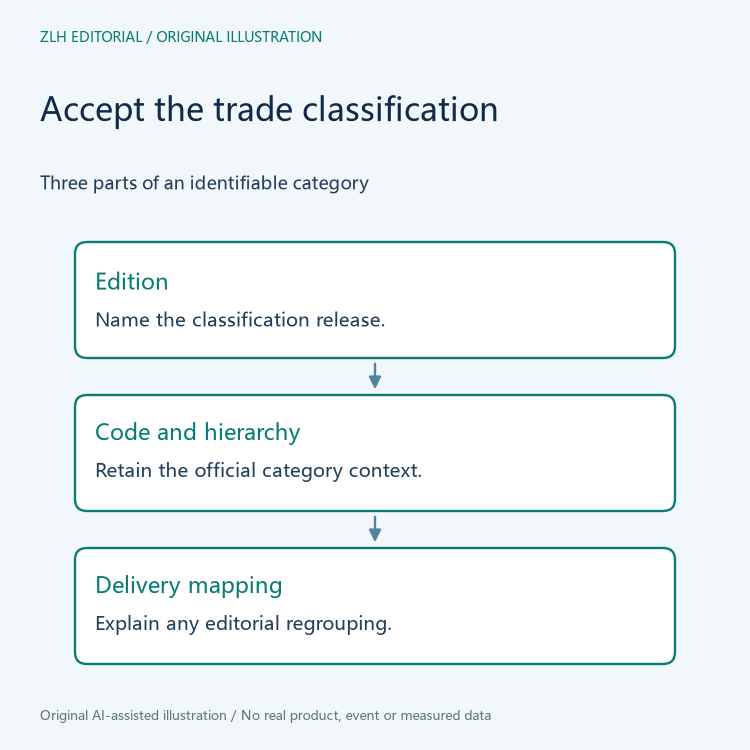
The United Nations Statistics Division's HS 2017 classification detail for 847950 places the six-digit subheading under heading 8479 in chapter 84. Its description identifies an industrial-robot machinery category with a residual qualification. Retaining the official description and hierarchy is more informative than replacing it with an unrestricted label covering all robotics products.
The page also explicitly identifies the edition as HS 2017. Record that context beside the code in the dataset documentation. A string of digits copied into a spreadsheet can lose the information that explains how it should be interpreted. An acceptance reviewer should be able to reconstruct the code's source without guessing which classification release the supplier intended.
This reading does not decide which code an actual robot, component or combined shipment should receive. Product classification can involve facts and rules beyond the detail page inspected here. A data delivery should retain any classification decision supplied by its responsible source rather than presenting an editor's broad interpretation as an official determination.
Treat a correspondence as an identified relationship
The same UNSD detail page displays a correspondence to HS 2012 and another classification reference. That information can help a recipient locate related entries. It does not justify deleting the edition field from a multi-year dataset. The delivered series should state whether it retains original classifications or applies a documented mapping to a chosen basis.
Matching digits in the displayed correspondence are an observation about those identified entries. They are not proof that every category in two complete classification editions is unchanged. Nor do they establish that an unknown provider has already mapped its historical data correctly. If a delivery combines editions, ask for the actual mapping record and the treatment of affected observations.
For a derived table, distinguish the original source code from the analytical grouping used for presentation. A grouping labelled robotics equipment might intentionally cover several categories, but the contributor should explain that construction. Otherwise a reader may mistake an editorial aggregate for a single official commodity category and repeat that mistake in later comparisons.
Keep trade categories separate from installation measures
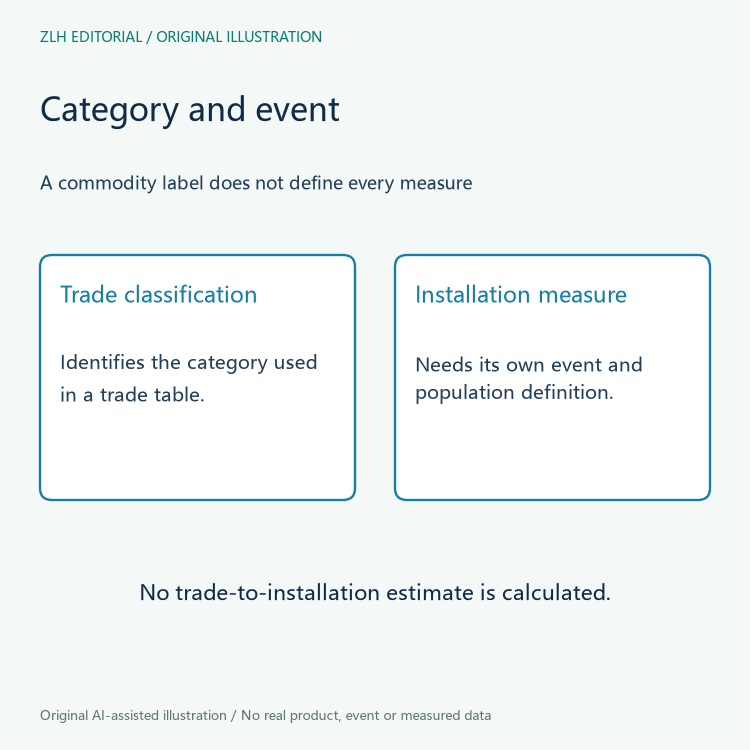
The International Federation of Robotics' World Robotics overview describes the statistical department's focus on global robot installations and lists several kinds of information available in its industrial-robot publication, including production, exports and imports. The page's separation of these subjects is useful context for reading a market-data delivery. A trade-category label alone does not identify an installation event.
Consequently, a recipient should not rename an imported-commodity measure as new installations merely because both concern industrial robots. A proposed connection between the measures needs its own documented method and applicable data. The two public pages linked here do not provide such a reconciliation for an arbitrary country and year. No installation estimate is calculated in this article.
The same caution applies to geographical labels. The place associated with a trade flow and the place associated with deployment need explicit definitions in their respective datasets. Before accepting a comparison, ask the contributor to preserve those definitions and explain the intended analytical relationship. A visually tidy shared country column cannot answer that substantive question by itself.
Close the acceptance task with a traceable classification account
A useful acceptance package includes the original classification edition, the complete source description, the retained hierarchy and any documented transformation into editorial groups. The measure's event and unit should remain separately visible. If those items are missing, record the unresolved question and avoid approving a chart title that promises more than the table can support.
The two original illustrations show documentation relationships without measured trade flows or invented market shares. Related reading appears in the robotics industry data collection and the article directory. A robot trade dataset becomes easier to assess when its code remains attached to an edition and its values remain attached to the event they actually describe.


