

Robotics ECDF Reading: Cumulative and Survival Functions
2026-11-05
Robotics ECDF Reading: Cumulative and Survival Functions
An ECDF summary can place two probability objects beside the same sample values. If a robotics data note calls both simply percentage, a reader may lose which side of a threshold the statement concerns. SciPy returns an empirical cumulative distribution function and its complementary empirical survival function. Their relationship helps an editor preserve the direction of the claim. This article reads the documented output and input scope; it does not analyze a real robotics dataset or estimate an industry trend.
Identify the returned function before interpreting a number
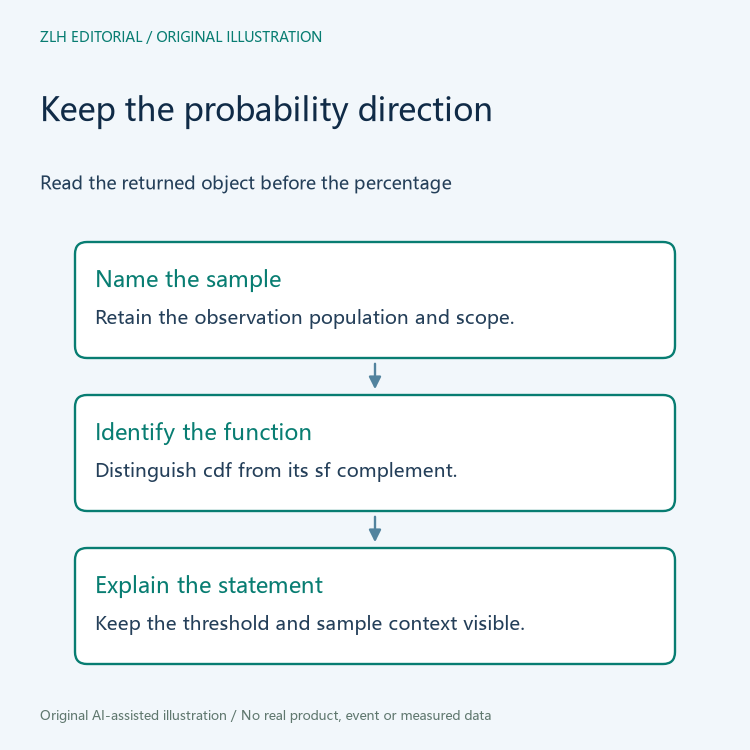
The official SciPy ecdf reference describes an empirical CDF as a step-function estimate of the distribution underlying a sample. Its result contains cdf and sf objects, with the latter representing the complementary empirical survival function. A label that preserves only the sample value and a probability can therefore be incomplete: the function identity is part of the interpretation.
For a robotics research summary, identify the underlying observation population and the quantity being summarized. A function applied to a sample does not establish that the sample represents every robot, company or installation. Keeping that scope visible is a separate editorial responsibility from reading the software output correctly. A well-named field can answer the software question while the sampling question remains open.
Keep cumulative and complementary directions distinct
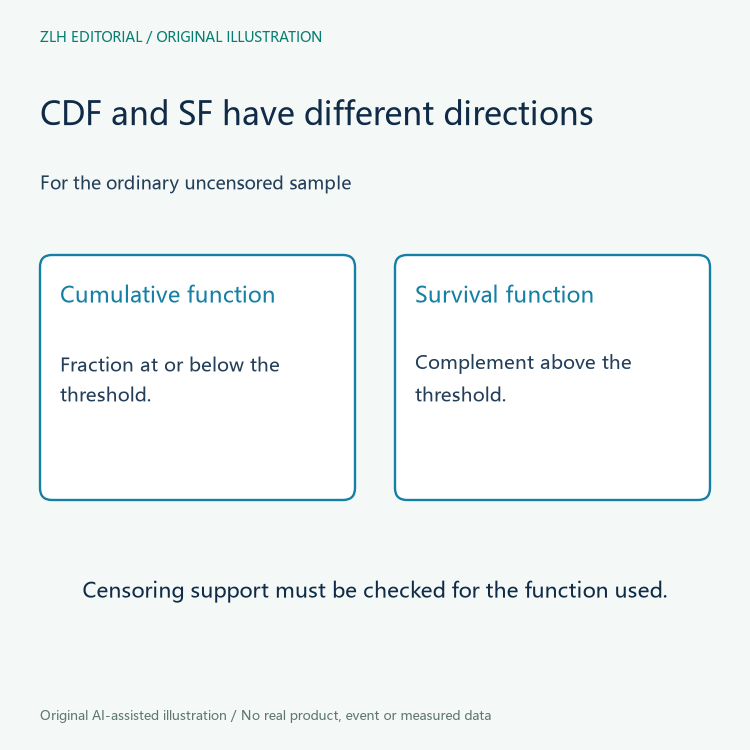
A cumulative statement and its complementary survival statement describe opposite sides of the same threshold. The note should say which function supplied the probability rather than relying on a chart's general appearance. A reader who sees a percentage without that direction cannot reliably tell what proportion the author means. Preserve the threshold and the function name together when shortening a table or caption.
For an ordinary uncensored sample, the empirical CDF gives the fraction of observations at or below a threshold. Its survival complement concerns observations above that threshold. The distinction includes what happens to observations equal to the threshold; they belong to the cumulative side. This explanation concerns the usual uncensored sample, while the separate censoring discussion below retains the function's documented input restrictions.
Imagine a fictional report whose worksheet names sf but whose summary calls the output a cumulative percentage. The editor should request the intended interpretation and return to the retained result. No new estimate is needed to recognize that the label has changed its subject. This invented example contains no actual company data, reliability study or numerical finding; it illustrates a correction to explanatory wording.
Read the result's quantiles and probabilities in context
The ecdf reference lists quantiles as the unique sample values defining the empirical CDF or SF, with corresponding point probability estimates. The field name should not tempt an editor to import an unrelated quantile estimator convention. Read the attribute according to this result object's own documentation. The result also offers evaluation and plotting methods, which remain separate from the identity of the input sample.
Both objects can be discussed without drawing a measured curve. A handover note might identify which output was used, how its threshold was described and where the input population is documented. That is sufficient to make the interpretation reviewable. It does not establish that a particular empirical pattern predicts future market behavior or that a threshold is appropriate for a purchasing decision.
The word survival is the name of the complementary statistical function in this interface. Its application meaning still depends on the quantity in the sample. A robotics data editor should not rename an ordinary numeric summary as equipment lifetime merely because the output object is called sf. Start with the recorded quantity, retain its observation definition and then explain the function's direction. This keeps the vocabulary useful without inventing a different study.
Keep censored observations within the supported input scope
The official CensoredData reference explains observations whose exact value is unknown but has a known bound or interval. That representation has its own meaning. It should not be flattened into an exact observed value merely to fit a simpler table. A bound supplies information, but it does not become a precise measurement because it occupies a numeric cell.
The ecdf page specifically supports uncensored and right-censored observations in the documented CensoredData input context; it says other forms are not currently supported. The broader class can represent additional forms, so class capability should not be mistaken for capability of every function that receives data. Preserve the function-specific restriction when describing an analysis workflow. This article offers no advice about choosing a statistical model.
Write a data note that retains its direction and limits
A useful closing explanation identifies cdf or sf, retains the threshold and states what observations the source sample contains. If censoring is present, preserve its representation and the applicable function support. If those details are missing, request them before rewriting a probability as a broad industry conclusion. Clarifying a label is a narrower result than validating the dataset or its interpretation.
The sources were read on November 5, 2026, in the current SciPy reference context. Keep an actual project's software version and preparation record with its result. The two illustrations are original conceptual reading aids, with no invented probability curve or measured values. Related material appears in the robotics industry data collection and article directory. A precise ECDF description keeps the probability direction and the sample's limitations visible to the next reader.


