

Robot Count Models: Binomial Trial Count and Location
2026-11-05
Robot Count Models: Binomial Trial Count and Location
Binomial model parameters can be copied correctly while their roles are described incorrectly. In SciPy, the trial count n and the location parameter loc do different things. One belongs to the definition of the count experiment; the other shifts the distribution's support. A robot industry data note should retain that distinction before calling either value an observed population size. This article reads model documentation and contains no fitted model or real industry dataset.
State what the count variable represents
A statistical model needs a defined random variable. A note about robot-related records should say what one trial represents and what outcome is being counted as a success. These definitions cannot be recovered from the word binomial alone. They also should not be borrowed from an unrelated regional total merely because both subjects involve counts.
The sources here belong to SciPy 1.16.0 and were read on November 5, 2026. They explain a software distribution and its mathematical interpretation. They do not establish that any particular robot adoption, installation or equipment dataset satisfies the model's assumptions. Keeping that boundary visible prevents a method description from becoming an unsupported statement about the industry.
Read n as a trial count in the documented model
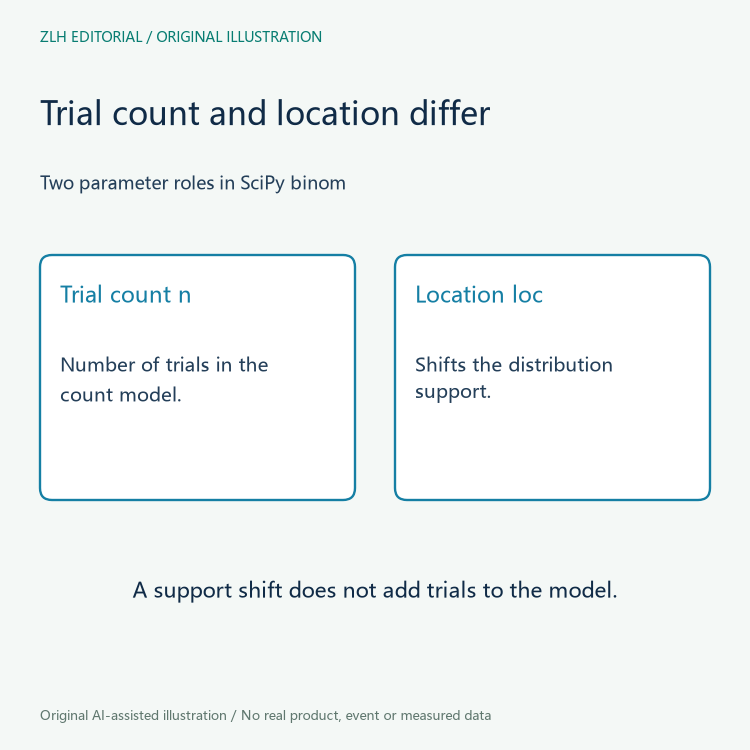
The official Binomial Distribution tutorial describes the variable as a count of successes in n independent trials, with success probability p. Equivalently, it describes a sum of independent Bernoulli variables with that probability parameter. The trial count therefore has an experimental meaning, rather than serving as an arbitrary horizontal shift.
The official binom reference gives the standard support as the integers from zero through n and identifies n and p as shape parameters. A model account should preserve the meaning of those parameters alongside the chosen variable. The support describes possible model values; it is not a list of observations collected from factories or regions.
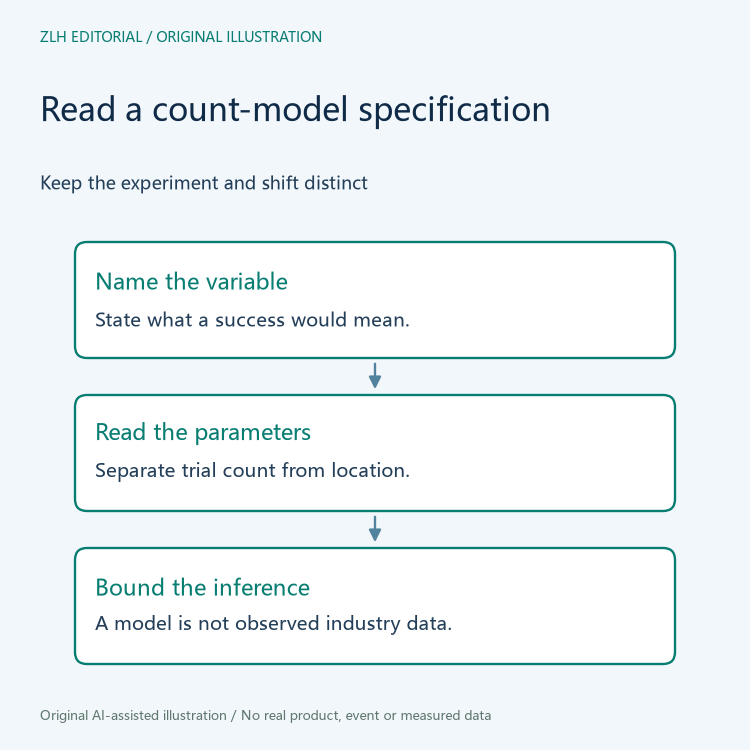
Read loc as a support shift
The binom reference separately explains that loc shifts the distribution. Its probability-mass relationship evaluates the standard form at the requested value minus loc. This is a change in where the distribution's possible values are located, while retaining the specified trial count and probability parameters. It should not be described as adding more trials to the underlying count experiment.
The official discrete-distributions overview gives the same general location-shift relationship for discrete variables, using an integer location parameter. This provides context for the role of loc in the specific binomial interface. A model note should explain any shifted variable being represented rather than attach a location value to an unexplained industry count.
Keep shifted support separate from new evidence
A mathematical shift does not generate additional survey responses or newly observed robot installations. If an author shifts a modeled variable, the method account should identify the transformed quantity. A plot or a table of probabilities from that model remains derived material, even when its horizontal labels resemble the labels of an observed count table.
Changing n answers a different modeling question from changing loc. The first changes the stated number of trials in the documented experiment; the second changes the support's location. A recipient should ask which role an attachment intends to express. The existence of both parameters in a software interface does not justify treating them as interchangeable ways to reconcile an unexplained total.
Check a fictional model appendix
Imagine a fictional robot study appendix that labels loc as “extra trials” while listing n in another column. The appendix includes no explanation of the represented variable. The correction is to separate the trial definition from the support shift and request the missing variable description. This invented example supplies no real sample size, probability or industry estimate.
A second problem would arise if the summary called the model's support a record of observed outcomes. Documentation of possible values cannot show which values occurred in a study. Keep the observed input, any transformation and the model specification distinguishable. If the author later provides an actual analysis, its results need a separate account of the data and calculation performed.
Close the reading with assumptions and provenance visible
A useful method note names the random variable, defines a trial and success, identifies n and p, and explains whether an integer location shift is used. It also states which supplied document supports those choices. This article does not recommend the binomial model for a particular industrial dataset, select parameters or claim that an empirical distribution was successfully fitted.
The original figures depict parameter roles without simulated or measured probability bars. The source's example plot was reviewed as documentation and is not reproduced as industry evidence. Further reading appears in the robot industry data collection and article directory. Keeping the trial count and location shift distinct makes a model specification readable before anyone interprets its proposed results.


